
Arithmetic, shifts, and rotates
Adder
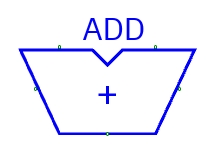
Inputs: A, B data buses and scalar CI carry-in. Outputs: S sum
and scalar CO carry-out. Data widths match the configured width (default 8).
S is the low-width sum; CO is the overflow carry. Connect CI to Ground for a zero carry-in. For eight bits, A=255, B=2, CI=1 → S=2, CO=1. Four-state carry logic propagates controlling/unknown bits rather than converting the whole sum into a machine integer.
The output is a bit vector; whether it represents signed or unsigned data depends on your interpretation. CO reports the carry out.
Multiplier
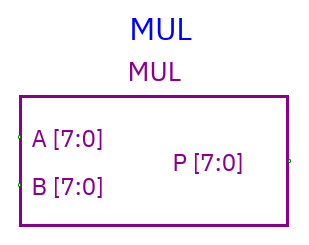
Inputs: A and B; output: P. Overall Bit width controls P. Operand A width and Operand B width can be configured separately; defaults match P. All are 1–4096 bits.
Operands are interpreted unsigned. Product is truncated to P's width. A=20, B=20, output width=8 → P=144 because 400 modulo 256 is 144. Unknown/floating operands produce unknown output.
Divider
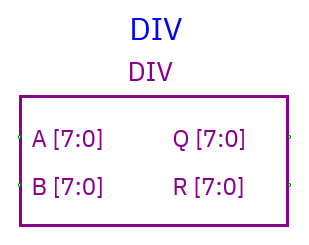
Inputs: A dividend, B divisor. Outputs: Q quotient and R remainder. A/B widths can be configured independently; Q/R use the overall width.
Unsigned integer division: A=23, B=5 → Q=4, R=3. Narrow outputs truncate. Division by zero yields X. Unknown/floating operands also yield X.
Shared shift/rotate interface
| Component | Symbol |
|---|---|
| Shift left | 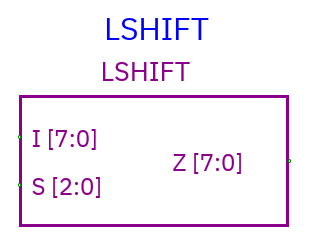 |
| Shift right | 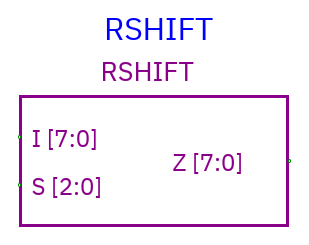 |
| Arithmetic shift right | 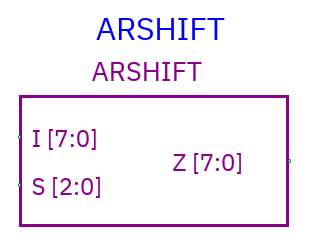 |
| Rotate left | 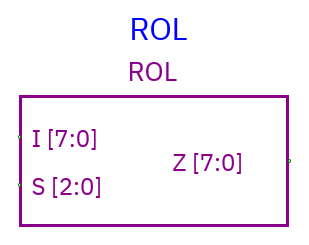 |
| Rotate right | 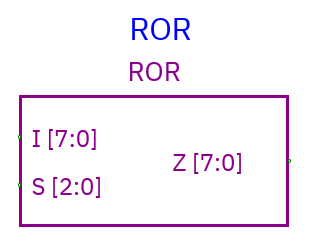 |
Inputs: I data and S amount; output: Z data. I/Z have matching widths. Newly created S pins use ceiling(log2(data width)), with at least one bit. Eight-bit data therefore has a 3-bit selector, representing 0–7. Existing documents retain their saved pin layouts, which may use a wider selector.
Use a three-bit source for an eight-bit shift amount, with values from 0 to 7. Unknown S produces X. Data X/Z bits are preserved when moved; inserted zero bits are known zeros.
| Component | Operation |
|---|---|
Shift left (LSHIFT) |
Move toward higher bit indexes; insert zeros at low end |
Shift right (RSHIFT) |
Move toward lower bit indexes; insert zeros at high end |
Arithmetic shift right (ARSHIFT) |
Right shift; fill high bits with original sign bit |
Rotate left (ROL) |
Shift left with high bits wrapping into low end |
Rotate right (ROR) |
Shift right with low bits wrapping into high end |
On eight-bit I=0x81 and S=1: left shift=0x02; logical right=0x40; arithmetic right=0xC0; rotate left=0x03; rotate right=0xC0.
Rotate amount wraps modulo data width. A logical shift at or beyond width, if a saved select pin allows it, yields zero; arithmetic right repeats the sign bit. Arithmetic shift takes its sign from the top bit.
Wide values
Arithmetic supports buses from 1 to 4096 bits. Enter wide values in hexadecimal or decimal, and choose operand/output widths to retain the bits you need.